
Rhipsalis floccosa subsp. oreophila N. P. Taylor & Zappi
Images | Description | Publications | Reduced Synonyms

Description
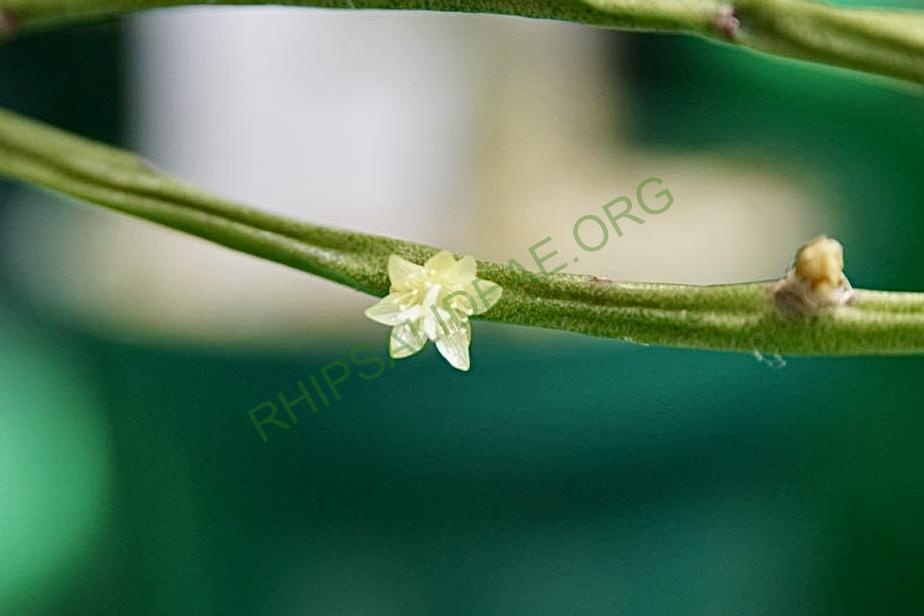
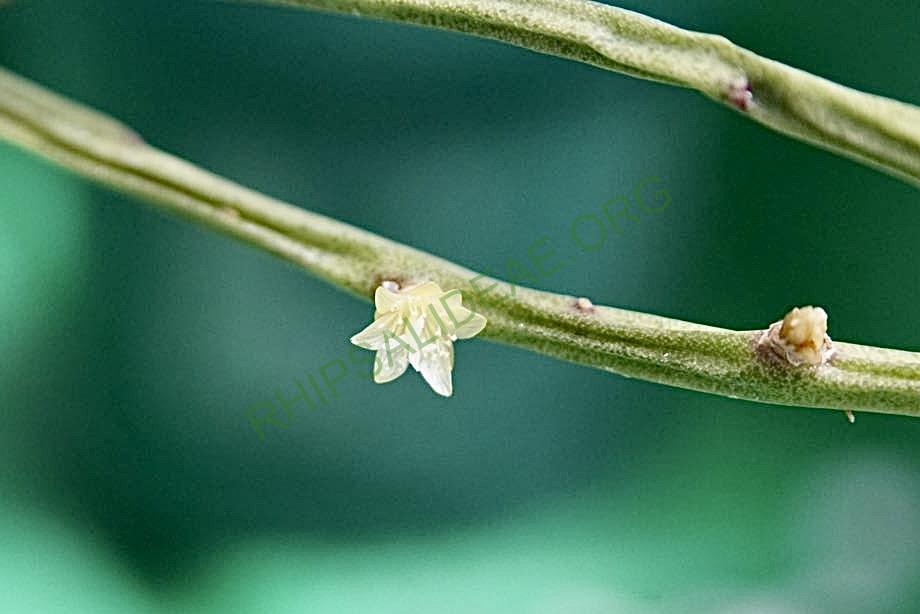
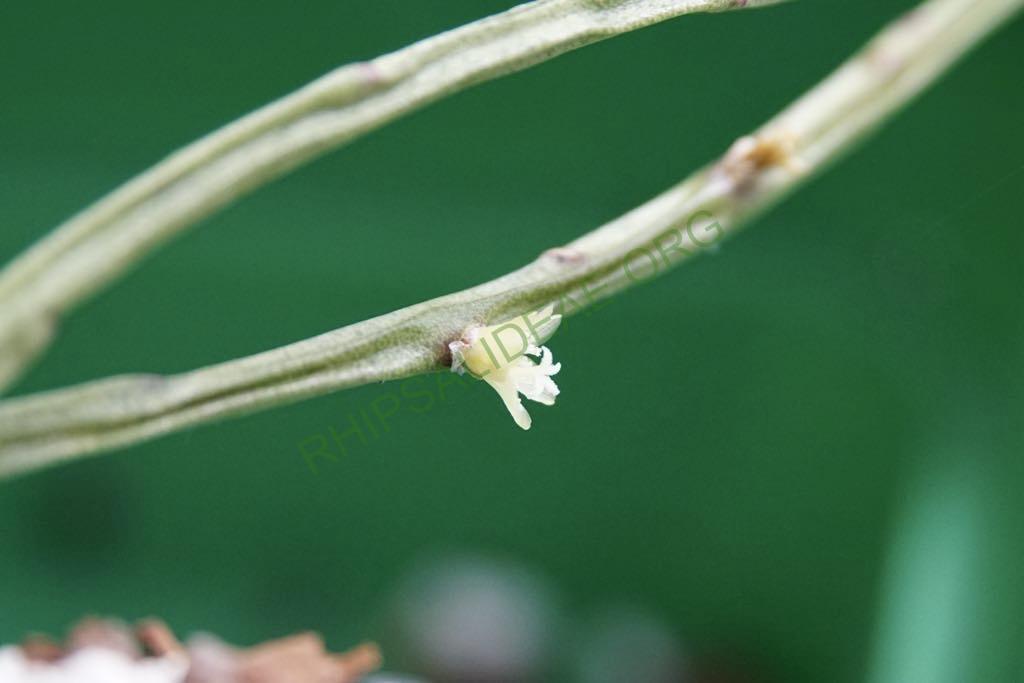
| The accepted name Rhipsalis floccosa subsp. oreophila N. P. Taylor & Zappi was published in Cactaceae Consensus Init. 6: 7. 1998. The geographic range is Chapada Diamantina and Serra do Espinhaço, Bahia and northern Minas Gerais found at elevations of 1200-1750 meters with an endangered status of least concern. Rhipsalis floccosa subsp. oreophila is classified in the subgenus Calamorhipsalis. Observed growing as an epiphyte. Overall habit is pendant, branches are monomorphic (single stem shape) and acrotonic (stems form from the tips of previous stems). Stems are round, bristles are absent. Main stems are determinate (seasonal growth is about the same length), 5cm-20cm x 0.3cm-0.6cm. Flowers are rotate: sub-patent or patent (wheel shaped: partial to wide open), 0.75cm x 1.2cm. Petals 6, sepal count is unreported. Inner petals are white, cream or cream-green, outer petals are white, cream, green or pink. Stamen are white, 33. Stigma lobes 4. Flower ovary is subglobose, unreported x 0.2cm. Flowering position on the stem is lateral and the flower orientation in relation to the stem is oblique. Does repeat flowering per areole. A maximum of 1 flowers were reported at a single areole. Areole position in the stems is deeply immersed (flower ovary is partially or fully hidden in the stems during bud development). Trichomes or wool is dense at the areoles after flowering. Unripe fruit is white-green. Ripe fruit is obconical-globose; white, unreported x 0.5cm. Other notable features: Ripe fruit sometimes has a reddish ring at the top. Stems almost perfectly cylindrical, mostly lacking in the raised podaria (lumps or protrusions near the areoles) of the other R. floccosa subspecies. This species is most closely related to R. tucumanensis1 and is quite similar in appearance. The current taxonomy for this species is likely to change to more closely align it's relationship to R. tucumanensis than R. floccosa1. 1Phylogeny and evolution of the epiphytic Rhipsalideae (Cactaceae), Nadja Korotkova, Ph.D. Thesis, 2012 Taxonomic treatment and description were derived from:
|
Rhipsalis floccosa subsp. oreophila referenced publications
| Title | Authors | Type | Journal | Year | Volume | Issue | Pages | Publisher |
|---|---|---|---|---|---|---|---|---|
| Epifytische cactussen, rhipsalis.eu. Accessed on: 15 Jan. 2025 | Aat van Uijen | Website | 2025 | |||||
| Royal Botanic Gardens Kew | Plants of the World Online. Accessed on: 15 Jan. 2025 | Website | 2025 | ||||||
| The Caryophyllales Network 2015+ [continuously updated]: A global synthesis of species diversity in the angiosperm order Caryophyllales. Accessed on: 15 Jan. 2025 | Website | 2025 | ||||||
| WFO The World Flora Online. Accessed on: 15 Jan. 2025 | Website | 2025 | ||||||
| Cactaceae at Caryophyllales.org – a dynamic online species-level taxonomic backbone for the family | Nadja Korotkova, David Aquino, Salvador Arias, Urs Eggli, Alan Franck, Carlos Gómez-Hinostrosa, Pablo C. Guerrero, Héctor M. Hernández, Andreas Kohlbecker, Matias Köhler, Katja Luther, Lucas C. Majure, Andreas Müller, Detlev Metzing, Reto Nyffeler, Daniel Sánchez, Boris Schlumpberger, Walter G. Berendsohn | Journal Article | Willdenowia | 2021 | 51 | 2 | 251 – 270 | Botanic Garden and Botanical Museum Berlin (BGBM) |
| Rhipsalis, cactussen uit het tropische woud 4 | Aat van Uijen | Journal Article | Succulenta | 2018 | 97 | 5 | 220-226 | |
| Rhipsalis spinescens Lombardi - eine kritische Bewertung unter Berücksichtigung neuer Funde | Andreas Hofacker | Journal Article | EPIG | 2017 | 79 | 5-15 | ||
| Rhipsalis (Cactaceae): loss and gain of floral rewards is mirrored in range sizes and distribution patterns of species | Bernadette Grosse-Veldmann, Stefan Abrahamczyk, Jens Mutke, Wilhelm Barthlott, Maximilian Weigend | Journal Article | Botanical Journal of the Linnean Society | 2016 | 180 | 491-503 | ||
| Phylogeny and evolution of the epiphytic Rhipsalideae (Cactaceae) | Nadja Korotkova | Ph.D. Thesis | 2012 | Rheinische Friedrich-Wilhelms-Universität Bonn | ||||
| What does it take to resolve relationship and to identify species with molecular markers? An example from the epiphytic Rhipsalideae (Cactaceae) | Nadja Korotkova, Borsch T, Dietmar Quandt, Nigel P. Taylor, Müller K, Wilhelm Barthlott | Journal Article | American Journal of Botany | 2011 | 98 | 1549-1572 | ||
| The New Cactus Lexicon: Atlas of illustrations | David Hunt, Nigel P. Taylor, Graham Charles | Book | 2006 | 104-120 | DH Books | |||
| The New Cactus Lexicon: Text | David Hunt, Nigel P. Taylor, Graham Charles | Book | 2006 | 138-139,142-143,253-257 | DH Books | |||
| Cacti of Eastern Brazil | Nigel P. Taylor, Daniela C. Zappi | Book | 2004 | The Royal Botanic Gardens, Kew | ||||
| Re-classification of Rhipsalideae, A Polyphyletic Tribe of the Cactaceae Durande | Alexander B. Doweld | Journal Article | Succulents | 2001 | 4 | 1-2 | ||
| Iii. Unterfamilie Cereoideae K. Schum. 1898 | Friedrich Ritter | Journal Article | Kakteen in Südamerika | 1979 | 20 | 1 | 36-47 |
Reduced Synonyms
| Name | Reduced by | Published Date | Published In |
|---|---|---|---|
| Rhipsalis monteazulensis F.Ritter | Taylor & Zappi (1998) | 1979 | Kakteen Südamerika 1: 42. 1979 |
| Hylorhipsalis monteazulensis (F.Ritter) Doweld | 2002 | Sukkulenty 4(1-2): 38. 2002 ["2001"] |