
Rhipsalis sulcata F. A. C. Weber
Images | Description | Publications | Reduced Synonyms
Bonn 4490, Domingos Martins, Espírito Santo, Brazil, collected by Rauh & Kautsky in 1986 – material sampled, Phylogeny and evolution of the epiphytic Rhipsalideae (Cactaceae), Nadja Korotkova, Ph.D. Thesis, 2012
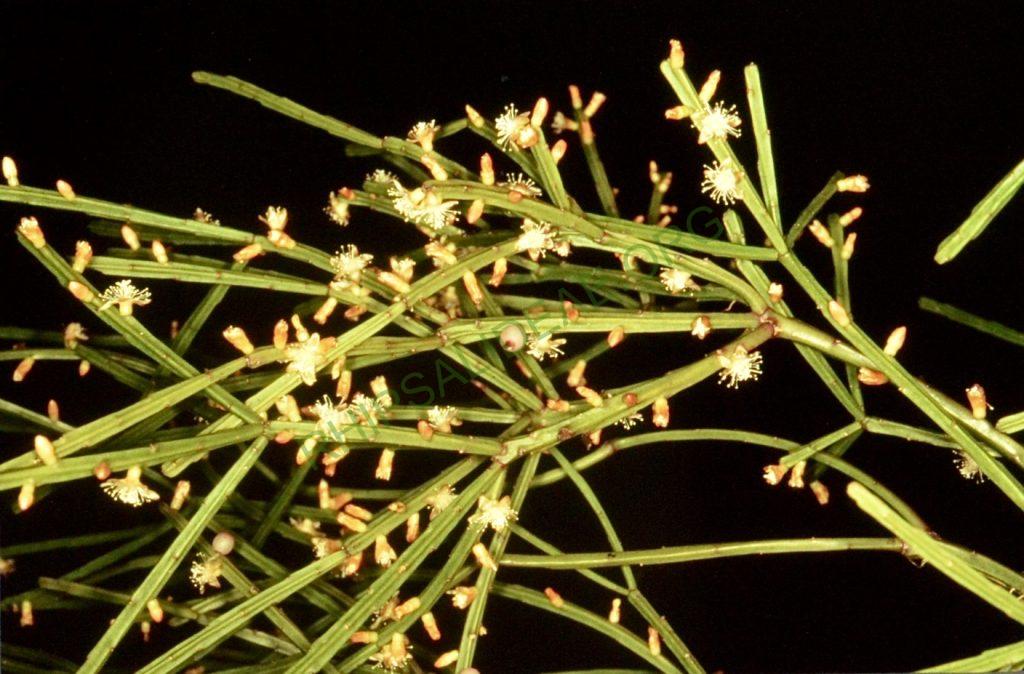

Utrecht University Botanic Gardens

Uhlig, HBG 122899 ex Uhlig
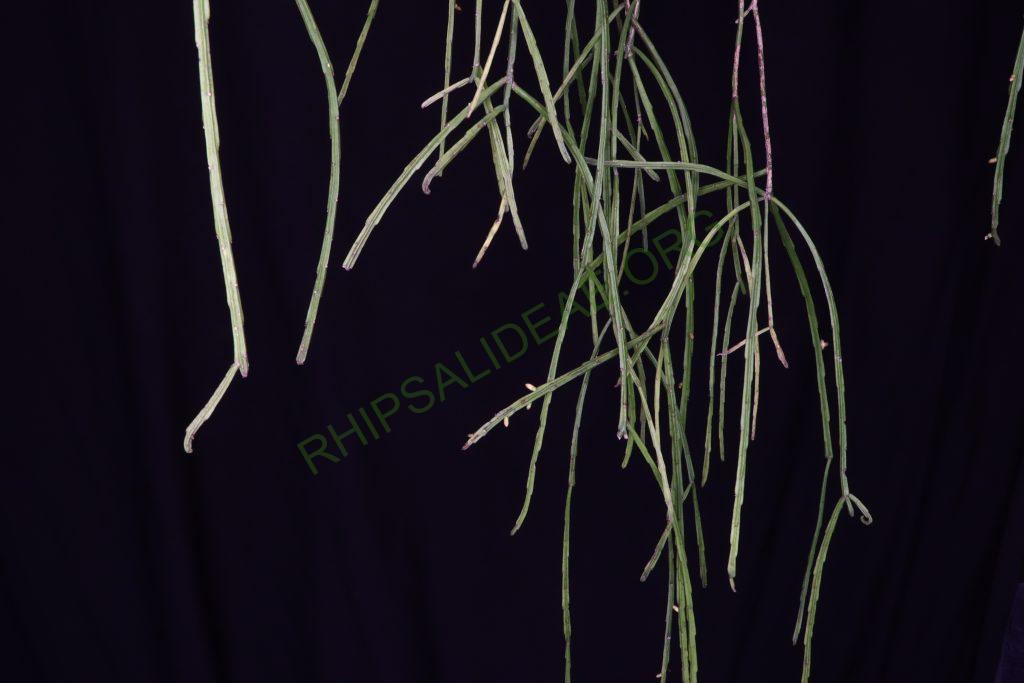


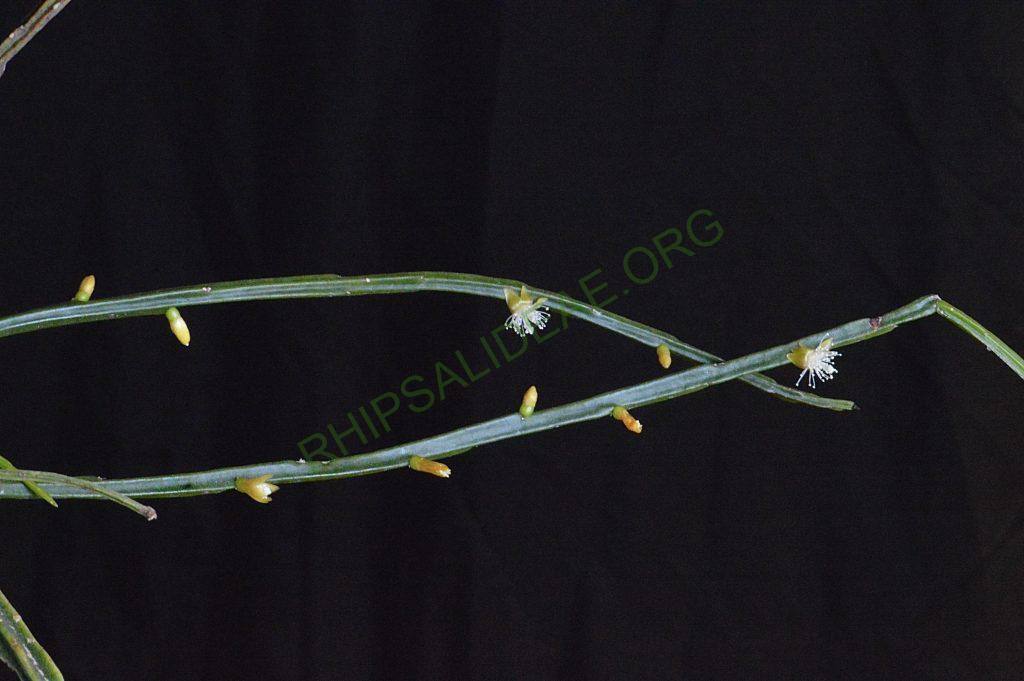


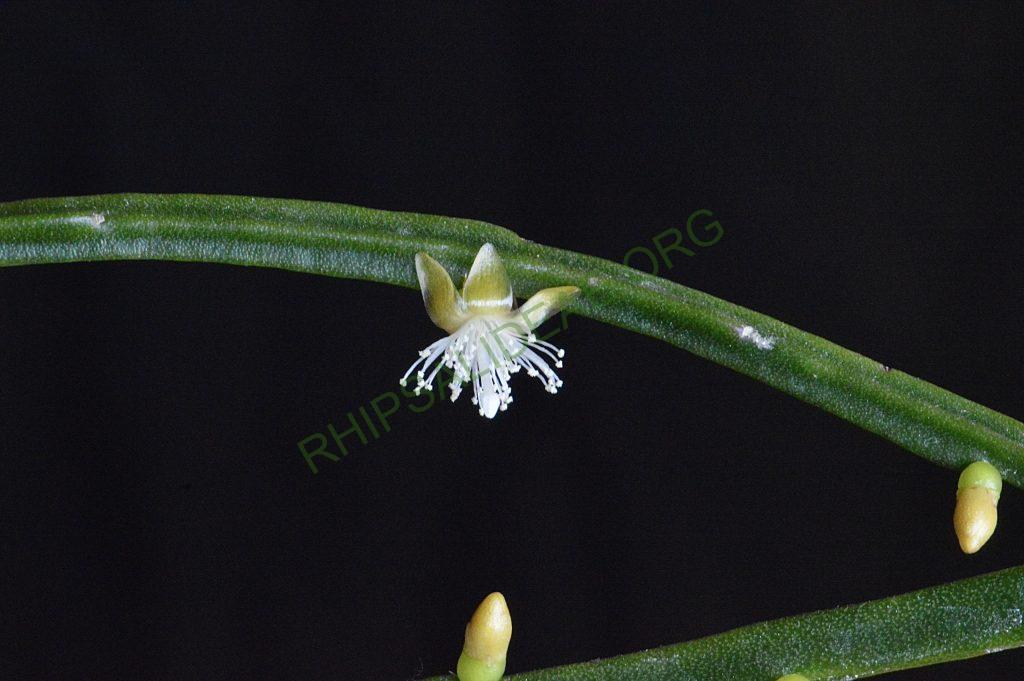
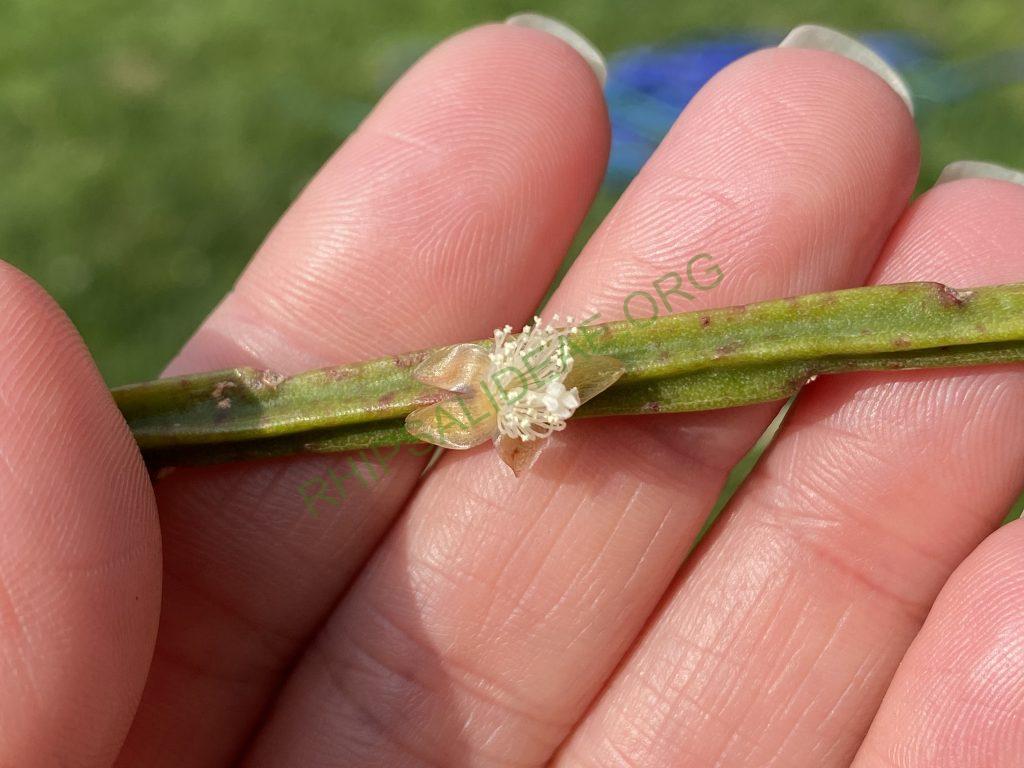
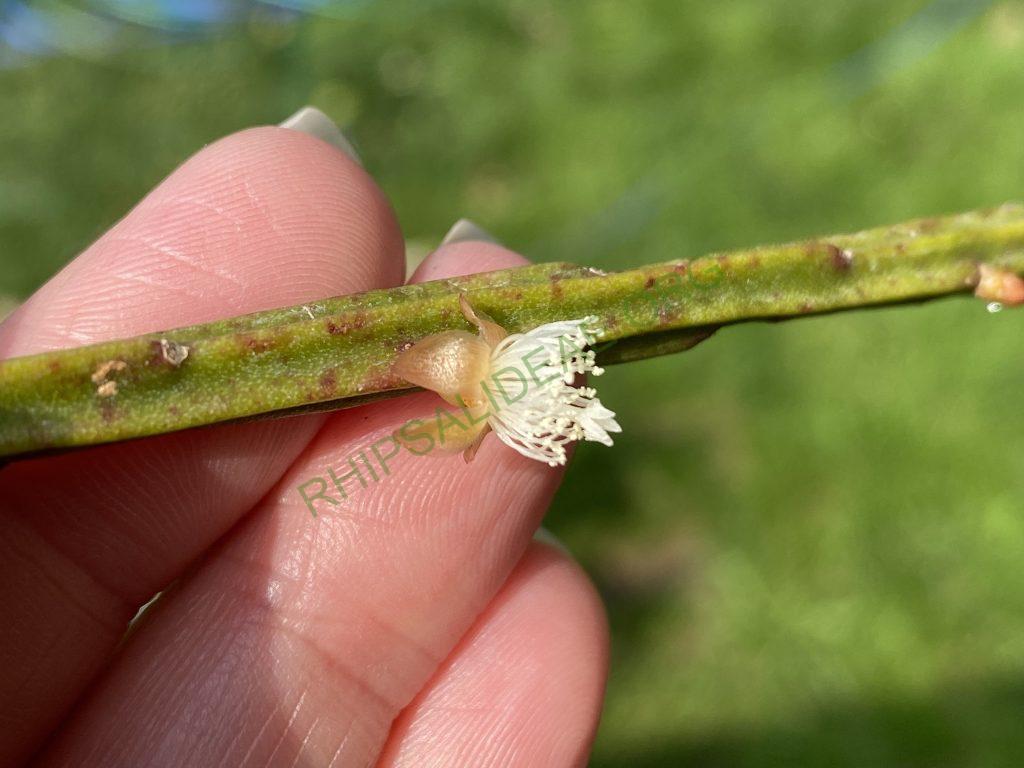

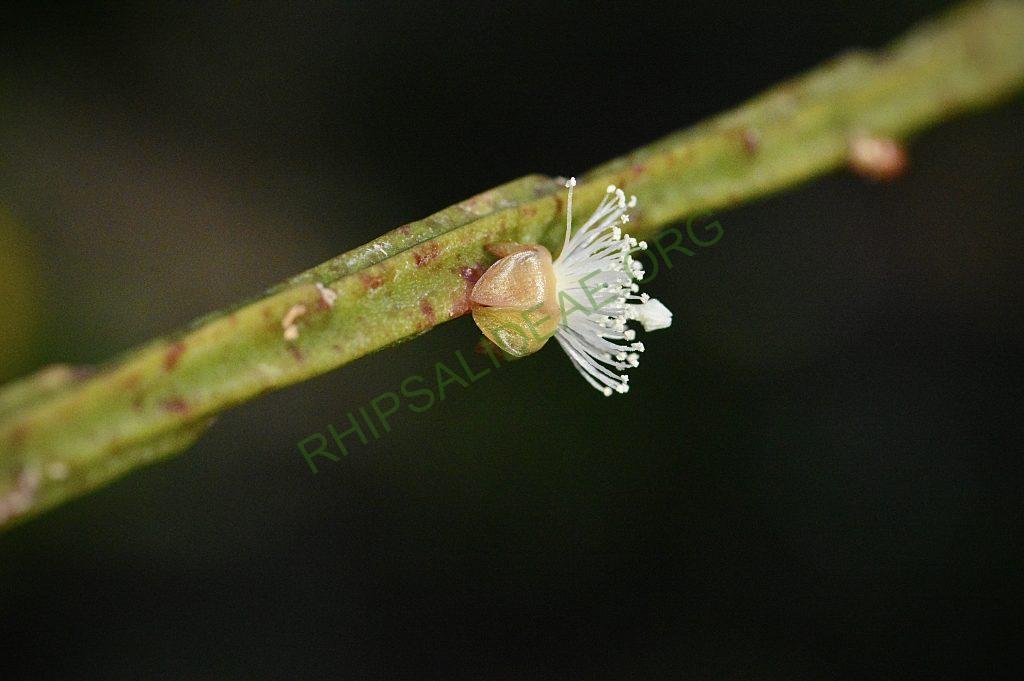


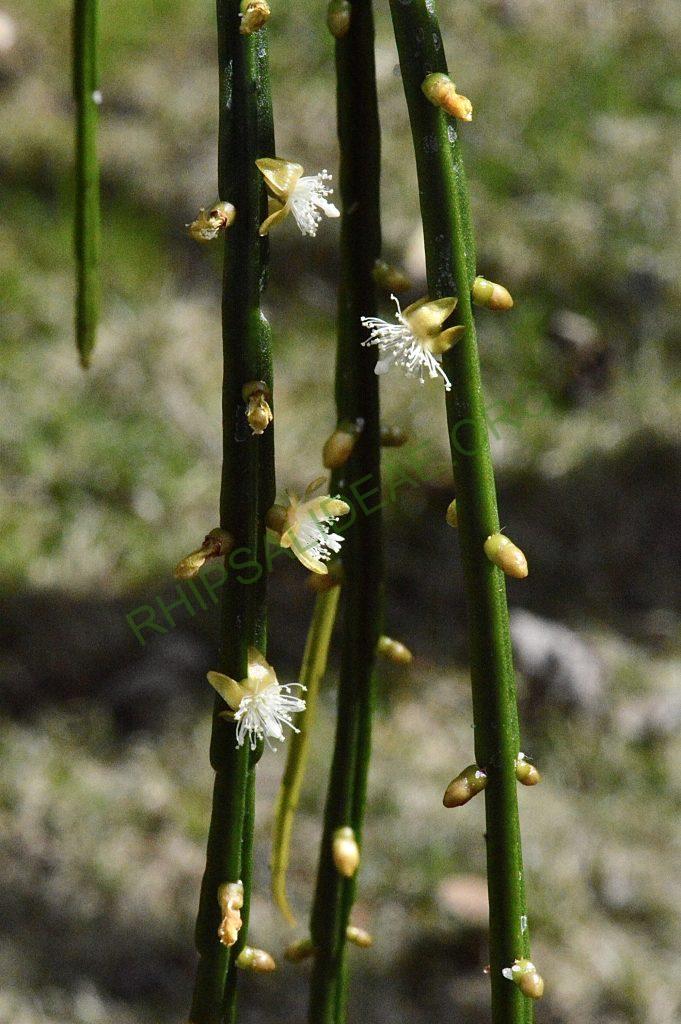
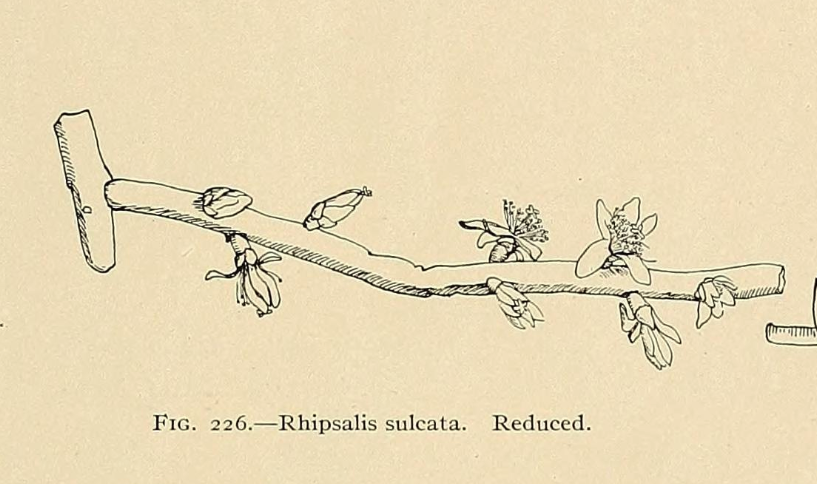
Botanical illustrations and historical images
Description
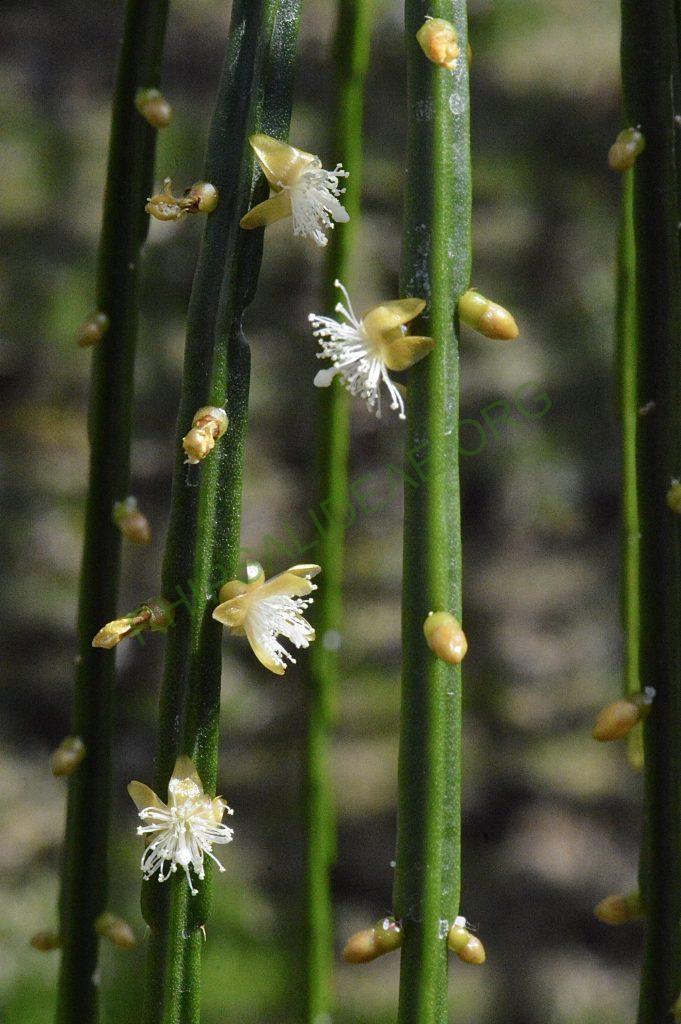
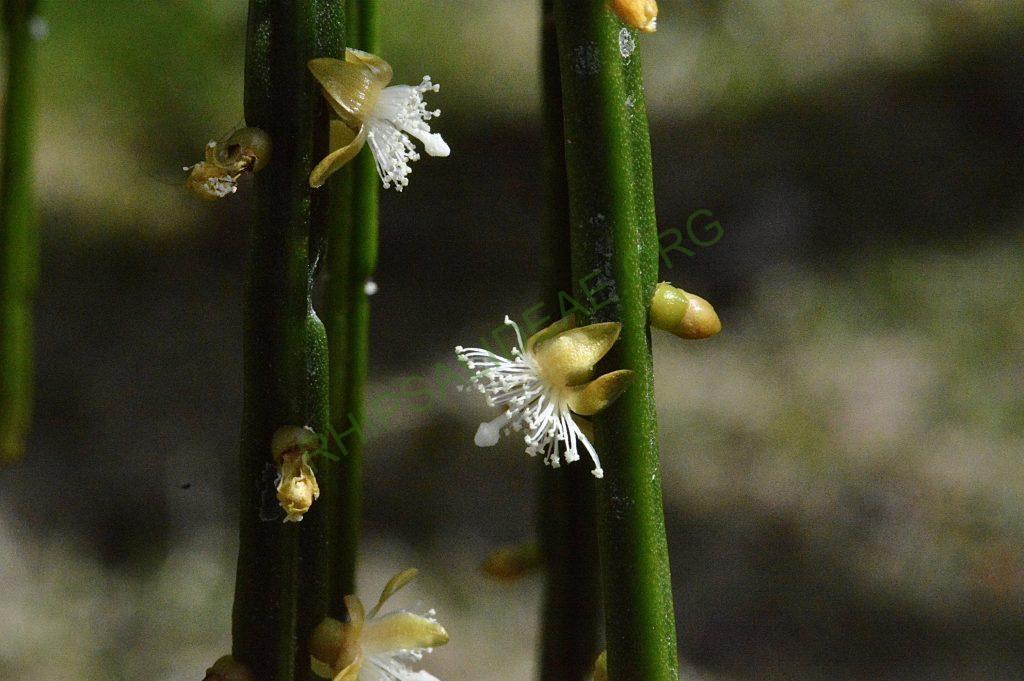
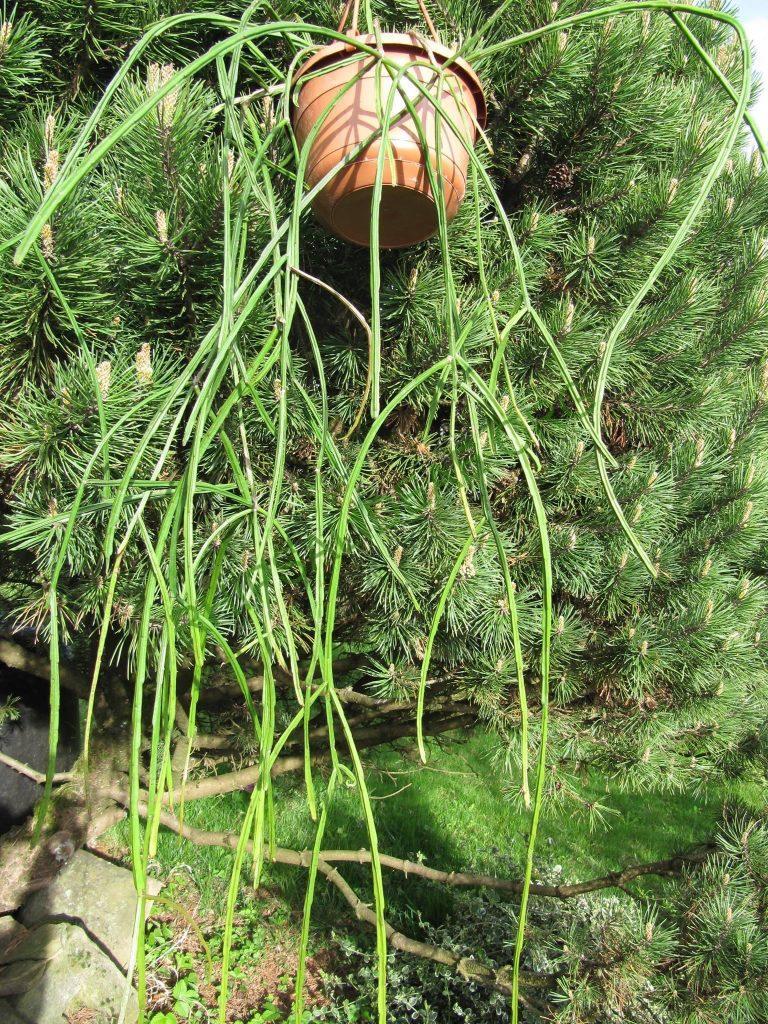
| The accepted name Rhipsalis sulcata F. A. C. Weber was published in Bois, Dict. Hort.: 1046. 1898. The geographic range is Brazil (Espírito Santo) found at elevations of unreported meters with an endangered status of data deficient. Rhipsalis sulcata is classified in the subgenus Rhipsalis. Observed growing as an epiphyte. Overall habit is pendant, branches are monomorphic (single stem shape) and acrotonic or subacrotonic (stems form from the tips and just below tips of previous stems). Stems are 3 to 5 angled, margins have very low crenations (very slightly scalloped), bristles are absent. Main stems are determinate (seasonal growth is about the same length), 20cm-30cm x 0.6cm-1.5cm. Flowers are rotate: reflexed (wheel shaped: reflexed), unreported x 1cm-1.5cm. Petals from 5 to 7, sepals from 1 to 2. Inner petals are white, light-yellow, yellow or pink, outer petals are yellow, pink, brown or red. Stamen are white, from 52 to 58. Stigma lobes from 3 to 5. Flower ovary is subglobose, unreported x unreported. Flowering position on the stem is lateral and the flower orientation in relation to the stem is perpendicular. Does not repeat flowering per areole. A maximum of 1 flowers were reported at a single areole. Areole position in the stems is superficial (flower ovary is visible on the surface of the stems during bud development). Trichomes or wool is sparse at the areoles after flowering. Unripe fruit is green, pink or red. Ripe fruit shape is unreported; white or pink, unreported x unreported. Other notable features: R. sulcata is commonly confused with R. pentaptera and R. micrantha f. kirbergii. It is distinguishable by having much longer thinner stems than either aforementioned species, yellow flowers, very short stout semi-globose flower ovaries, and more often than not 5-angled stems. The crenations are quite shallow in comparison to R. pentaptera. The flowers resemble those of R. teres f. heteroclada and it is more closely related to R. teres than the aforementioned species1. At times the quite long branches have shorter stems that develop at the apex that are 3 to 5 angled. The overall morphology of this species is quite long and pendant, some botanical texts described the overall plant morphology as resembling that of R. floccosa. 1Phylogeny and evolution of the epiphytic Rhipsalideae (Cactaceae), Nadja Korotkova, Ph.D. Thesis, 2012 Taxonomic treatment and description were derived from:
|
Rhipsalis sulcata referenced publications
| Title | Authors | Type | Journal | Year | Volume | Issue | Pages | Publisher |
|---|---|---|---|---|---|---|---|---|
| Epifytische cactussen, rhipsalis.eu. Accessed on: 15 Jan. 2025 | Aat van Uijen | Website | 2025 | |||||
| Royal Botanic Gardens Kew | Plants of the World Online. Accessed on: 15 Jan. 2025 | Website | 2025 | ||||||
| The Caryophyllales Network 2015+ [continuously updated]: A global synthesis of species diversity in the angiosperm order Caryophyllales. Accessed on: 15 Jan. 2025 | Website | 2025 | ||||||
| WFO The World Flora Online. Accessed on: 15 Jan. 2025 | Website | 2025 | ||||||
| The IUCN Red List of Threatened Species. Version 2024-2. accessed on 2025-01-07 | Website | 2024 | ||||||
| Cactaceae at Caryophyllales.org – a dynamic online species-level taxonomic backbone for the family | Nadja Korotkova, David Aquino, Salvador Arias, Urs Eggli, Alan Franck, Carlos Gómez-Hinostrosa, Pablo C. Guerrero, Héctor M. Hernández, Andreas Kohlbecker, Matias Köhler, Katja Luther, Lucas C. Majure, Andreas Müller, Detlev Metzing, Reto Nyffeler, Daniel Sánchez, Boris Schlumpberger, Walter G. Berendsohn | Journal Article | Willdenowia | 2021 | 51 | 2 | 251 – 270 | Botanic Garden and Botanical Museum Berlin (BGBM) |
| Cactaceae in Flora do Brasil 2020. Jardim Botânico do Rio de Janeiro. Accessed on: 15 Jan. 2025 | Daniela C. Zappi, Nigel P. Taylor | Website | 2020 | |||||
| Rhipsalis, cactussen uit het tropische woud 3 | Aat van Uijen | Journal Article | Succulenta | 2018 | 97 | 4 | 163-166 | |
| Rhipsalis, cactussen uit het tropische woud 1 | Aat van Uijen | Journal Article | Succulenta | 2017 | 96 | 6 | 270-275 | |
| Rhipsalis (Cactaceae): loss and gain of floral rewards is mirrored in range sizes and distribution patterns of species | Bernadette Grosse-Veldmann, Stefan Abrahamczyk, Jens Mutke, Wilhelm Barthlott, Maximilian Weigend | Journal Article | Botanical Journal of the Linnean Society | 2016 | 180 | 491-503 | ||
| Phylogeny and evolution of the epiphytic Rhipsalideae (Cactaceae) | Nadja Korotkova | Ph.D. Thesis | 2012 | Rheinische Friedrich-Wilhelms-Universität Bonn | ||||
| Molecular Phylogeny, Evolution, and Biogeography of South American Epiphytic Cacti | Alice Calvente, Daniela C. Zappi, Félix Forest, Lúcia G. Lohmann | Journal Article | International Journal of Plant Sciences | 2011 | 172 | 7 | 902-914 | |
| What does it take to resolve relationship and to identify species with molecular markers? An example from the epiphytic Rhipsalideae (Cactaceae) | Nadja Korotkova, Borsch T, Dietmar Quandt, Nigel P. Taylor, Müller K, Wilhelm Barthlott | Journal Article | American Journal of Botany | 2011 | 98 | 1549-1572 | ||
| A Unique Cactus with Scented and Possibly Bat-Dispersed Fruits: Rhipsalis juengeri | Boris Schlumpberger, Robin A. Clery, Wilhelm Barthlott | Journal Article | Plant Biology | 2006 | 8 | 2 | 265-70 | |
| The New Cactus Lexicon: Atlas of illustrations | David Hunt, Nigel P. Taylor, Graham Charles | Book | 2006 | 104-120 | DH Books | |||
| The New Cactus Lexicon: Text | David Hunt, Nigel P. Taylor, Graham Charles | Book | 2006 | 138-139,142-143,253-257 | DH Books | |||
| Cacti of Eastern Brazil | Nigel P. Taylor, Daniela C. Zappi | Book | 2004 | The Royal Botanic Gardens, Kew | ||||
| Re-classification of Rhipsalideae, A Polyphyletic Tribe of the Cactaceae Durande | Alexander B. Doweld | Journal Article | Succulents | 2001 | 4 | 1-2 | ||
| Taxonomy and Phytogeography of the Cactaceae of Eastern Brazil | Nigel P. Taylor | Ph.D. Thesis | 2000 | |||||
| Die Namen der Gattungen und Arten epiphytischer Kakteen. Teil 1. Rhipsalideae | Ralf Bauer | Journal Article | EPIG | 1996 | 8 | 2 | 47-51 | |
| Notes towards a Monograph of Rhipsalideae (Cactaceae) | Wilhelm Barthlott, Nigel P. Taylor | Journal Article | Bradleya | 1995 | 13 | 43-79 | British Cactus and Succulent Society | |
| Bericht über zwei Vorträge von Myron Kimnach und Prof. Dr. Wilhelm Barthlott über ihre Ansichten zur Gattungsgliederung innerhalb der epiphytischen Kakteen | Ralf Bauer | Journal Article | EPIG | 1991 | 3 | 4 | 64-71 | |
| Cactus Lexicon | Curt Backeberg, Walther Haage | Book | 1966 | 205,220-222,440-449, 647, 750 | Blandford Press Ltd. (1966-1973) | |||
| Onze Gedoornde Vrienden. | Journal Article | Succulenta | 1924 | 6 | 12 | 170-179 | ||
| Hortus Mortolensis : enumeratio plantarum in Horto Mortolensi cultarum = Alphabetical catalogue of plants growing in the garden of the late Sir Thomas Hanbury ... at La Mortola, Ventimiglia, Italy | Giardino Botanico Hanbury, Alwin Berger | Book | 1912 | 272-273 | London, West, Newman, 1912 | |||
| Icones Selectae Horti Thenensis | M. Èm. de Wildeman | Book | 1904 | 5 | 135-137 | |||
| Dictionnaire d'horticulture illustré | D. Bois | Book | 1893 | 1045-1048 | P. Klincksieck |
Reduced Synonyms
| Name | Reduced by | Published Date | Published In |
|---|---|---|---|
| Hylorhipsalis sulcata (F.A.C.Weber) Doweld | Korotkova (2021) | 2002 | Sukkulenty 4(1-2): 39. 2002 ["2001"] |